


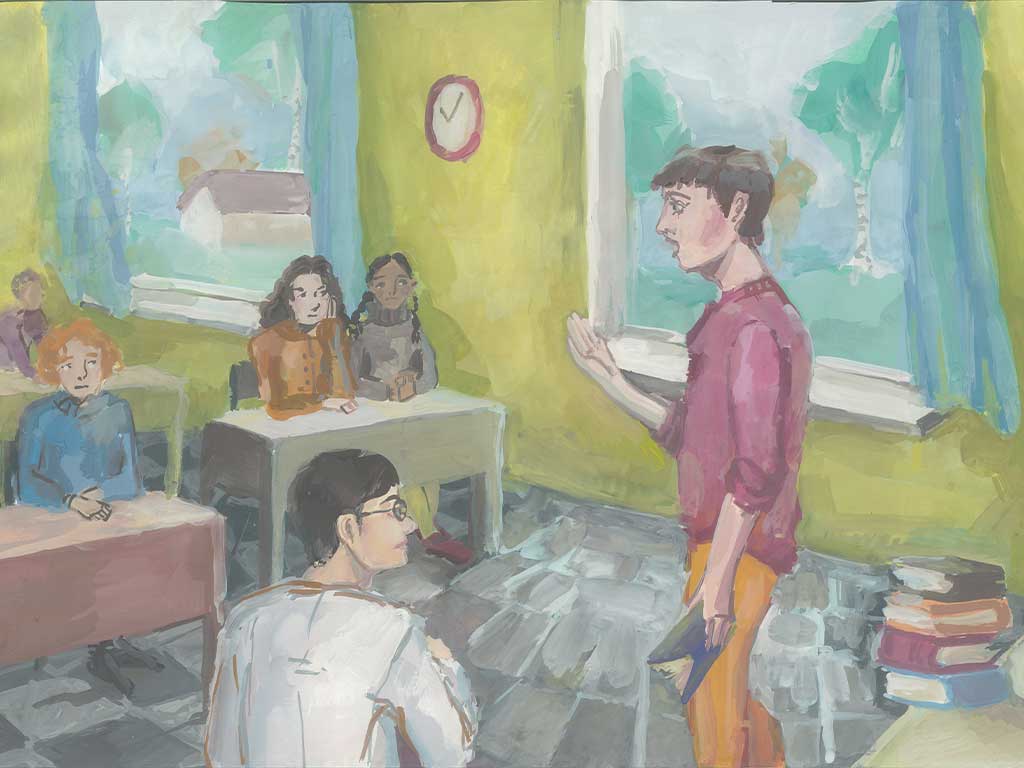
Chernyshenko Dasha, Odesa Ukraine, 16 years old, Challenge, March 2021, A3 paper.
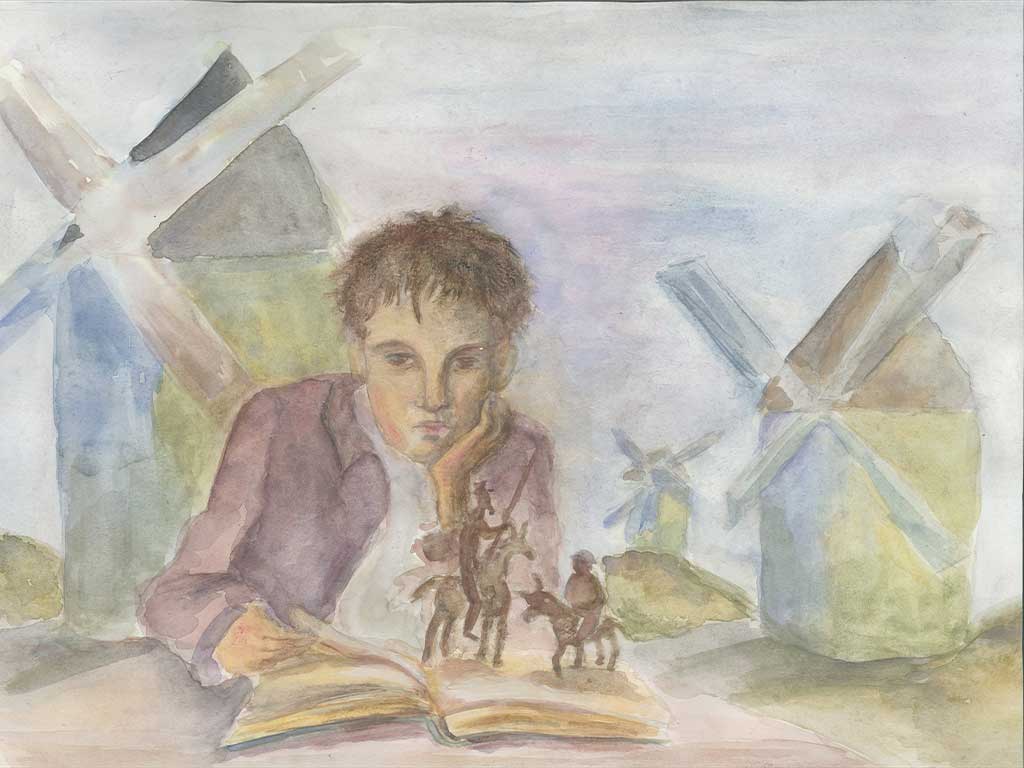
Navolotskaya Maria, Odesa Ukraine, 19 years old, Knowledge is power, March 2021, A3 paper.

Ilchenko Roman, Novovolynsk, Ukraine, 14-years-old, The teacher visits the student, May 2021, A3 paper

Pogorelova Anastasija, Novovolynsk, Ukraine, 13-years-old, Gifts for the classmate, May 2021, A3 paper

Yanytska Yuliana, Novovolynsk Ukraine, 13-years-old, Human Aura and Thoughts of Others, May 2021, A3 paper
Whether because of his surname or his constant scruffiness, scratches and cuts, nobody knew exactly why, but the other boys in the village school called him Brick. He had no father. When his mother came to school, if at all, she appeared unkempt and often confused.
Most of the teachers had a low opinion of Brick. They pointed out that he had been smoking since the third grade, and often fought with the other boys. They accused him of stealing, and often blamed him for all sorts of trouble.
One teacher, though, saw him differently. He noticed that Brick loved to read. After class, Brick told the teacher he had read Tom Sawyer seven times – nobody else had read it even once. He was eager to read Don Quixote, also, but the library wouldn’t lend it to him. An excerpt from The Toreadors from Vasyukovka had been in their textbook, and Brick wanted to read the whole book. With some hesitation, the teacher lent him his personal copy. After reading it, Brick returned it in perfect condition.
The class read a letter by Umberto Eco to his grandson in which he said it was important, at any age, to train one’s memory by memorizing a poem a week. The teacher suggested the class take up this challenge, but only Brick did so, and without embarrassment recited a poem in front of the whole class.
The teacher moved away. Then one day, on Facebook, he learned that Brick had been removed from the village and sent to a children’s home. The teacher contacted the home to see how Brick was getting along. He learned that Brick had run away from the home twice. He had actually made it back to the village, only to find nobody who wanted him.
The teacher decided to visit him at the children’s home. Knowing Brick’s curious nature, the teacher brought Brick a book, The Financier by Theodore Dreiser. He told Brick it would help him learn about making money, which could be very useful in the future. He encouraged Brick to stop running away, so he could study hard and go to college. Then he could learn a trade, and go back to the village if he wanted. The teacher did not promise to come back. He didn’t like making promises he wasn’t certain he could keep. Brick didn’t need that anyway.
When the teacher contacted the old village school, he told the class about Brick. It was almost New Year’s, so the students put together a package of sweets to send to Brick. One of the boys wrote a letter on a page torn from an exercise book, “How are you doing, Brick? When are you coming back? Give us a call if you need anything,” and included a mobile phone number.
Brick had thought nobody cared about him. With the encouragement of his former teacher and classmates, Brick gained a renewed sense of enthusiasm. He worked hard and was accepted into college. After he graduated, he moved back home to the village. He had earned his name – he was as strong, sturdy, and reliable as a brick.


