Asia West Pacific
How can Jeju remain an island of peace rather than an island of war?
By Jungjoo Gang Park
Reply to jooya29ATgmailDOTcom for feedback or comments
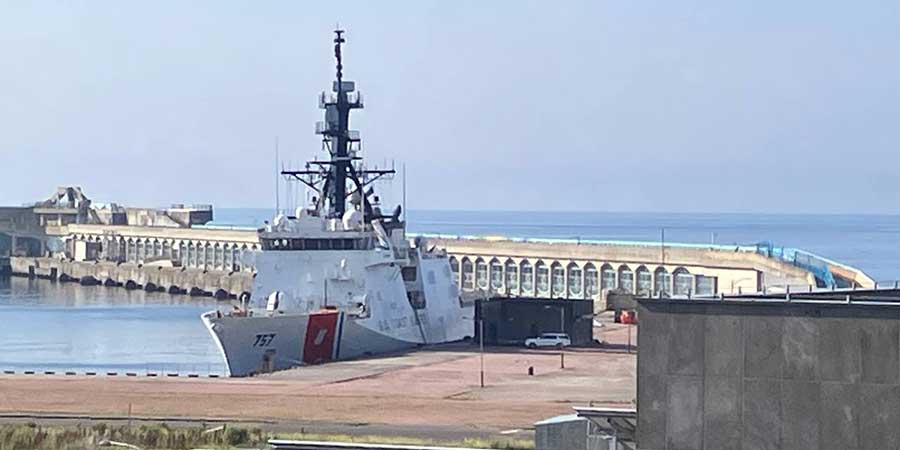
The US Warship(USCG )is berthed at the Jeju Naval Base on June 9, 2026. Photo Credit to Gangjeong Everyday Resistance Action
Standing at the main gate of the Jeju Naval Base, I look out toward the sea off Gangjeong. Gathering in this exact spot every day for over a decade has transformed this military base into a place of resistance action. Standing here, through the tightly closed iron gates, the inside of the military facility comes into view. On days when warships are berthed, gray steel structures completely block the view, hiding the sea entirely. The Jeju Naval Base was built atop a massive flat rock formation called Gureombi—and on top of the grave of the countless living beings that relied on it to survive. In the sea breeze blowing through the naval base, I sense the dark, ominous clouds of death. In that breeze, I hear the screams of children at the Minab Elementary School in Iran who died under the US bombings. In that breeze, I smell the blood and tears of Palestinians who endure inhuman treatment in Israel’s infamous prisons, where surviving itself is resistance. In that breeze, I feel the agonizing cries of the people on Miyako Island, at the edge of Okinawa, facing forced evacuation in preparation for potential wartime contingencies.
In the late afternoon, a berthed warship leaves the base with a massive blast of its horn. It sounds like a declaration telling us to head to the battlefield and prepare for war. Anxious foreboding washes over me, making me want to rush outside immediately and tell people: War might actually break out, and we must stop it.
Despite all the illegality, lies, deception, killing, and destruction, the Jeju Naval Base was ultimately built. Neither the fervent hopes of countless people nor their desperate self-sacrifice could stop the military from entering Gangjeong Village. People have somehow forgotten that a sacred piece of nature known as Gureombi Rock was killed by human hands. People live on having forgotten that state violence was committed here—just as during the Jeju April 3 Incident—where the state, police, and military assaulted, monitored, and deceived the people. It is as if the era of war has ended, as if such things will never happen to us again. In Gangjeong, after the frenzy of national projects and national security has swept through, the logic of capital and development thrives—a logic dictating that both people and nature can be simply destroyed.
Ten years have passed since its completion, and Jeju’s Gangjeong Village has become a military base town. Warships come and go, including foreign naval vessels—most of which are American. The Jeju Naval Base, under the glamorous title of “Civil-Military Complex Port for Tourism,” is in reality nothing more than a layover stop supporting the U.S. military’s Pacific war exercises. During their port calls, escorted by the South Korean Navy and police, American troops replenish military supplies, dispose of waste and sewage, and enjoy recreation. Without a single word of apology for the U.S. Military Government’s responsibility regarding the Jeju April 3 Massacres, they use Jeju Island as if it were their personal vacation home before departing.
Even prior to the construction of the naval base, concerns were raised that Jeju Island would face deepening militarization. Now, as the anti-naval base struggle approaches its 20th year, those concerns have become reality. Over the past decade of operation, the Jeju Naval Base has played a pivotal role in deepening the island’s militarization across various military-linked sectors. In the process, the base has established itself as a hub for the US nuclear submarines and nuclear aircraft carriers.
Furthermore, on February 3, 2025, the Navy Maritime Task Flotilla Command was established at the Jeju Naval Base, strengthening military power not only in response to security threats from North Korea, but also during joint South Korea-U.S.-Japan exercises and operations. In December of the same year, the Hanwha Space Center was completed in Hawon-dong, Seogwipo—just 15 minutes away from Gangjeong Village. According to Hanwha Systems, this facility aims to “upgrade the army, navy, and air force tactical networks using satellite communications” and “lay the foundation for the future military’s Multi-Domain Operations (MDO).” As the space industry becomes tightly interwoven with the military and security sectors, the construction of the Hanwha Space Center appears to accelerate Jeju Island’s militarization. Another major concern is the potential for Jeju’s second airport to become a military airport. In 2019, then-Air Force Chief of Staff Jeong Kyeong-doo publicly stated that they were actively reviewing plans to utilize the second Jeju airport alongside a Southern Search and Rescue Unit. In other words, they unreservedly expressed their intent to use it as a military airport.
On January 27, 2005, the South Korean government designated Jeju as the “Island of World Peace.” This was a national expression of commitment to remember the tragedy of the Jeju April 3 Incident and to realize the values of peace and coexistence. It also embodied the expectation that Jeju, geopolitically and strategically, would become a place for peaceful efforts in Northeast Asia.
Yet, what does Jeju Island look like today? It is becoming a military base island—the exact opposite of its title as the Island of World Peace. Jeju Island must not forget its history of war and oppression. In 1937, during the Second Sino-Japanese War when the Japanese military committed the Nanjing Massacre, Jeju Island was forced into becoming an unwilling participant in war as a layover site for bombers headed to attack Nanjing. Later, during the division into South and North Korea resulting from the Cold War, tens of thousands of Jeju people were massacred during the April 3 Incident. Today, through the Jeju Naval Base, Jeju secures military power, participates in war drills preparing for conflict in other regions, and conspires in war by supporting the armed forces of other nations preparing for war.
To stop Jeju from shifting from the position of a victim to that of a perpetrator, we shout again today in front of the Jeju Naval Base: Stop the war! Cease the war exercises! Close the naval base!
Someone must take to the streets and proclaim: Peace maintained by force is not peace! War brings death and destruction, not peace! We desperately need people like that—people who, standing at the edge of the world, hold back those about to fall into the abyss of war, preventing it from happening. And here in Gangjeong, we strive to be those very people.
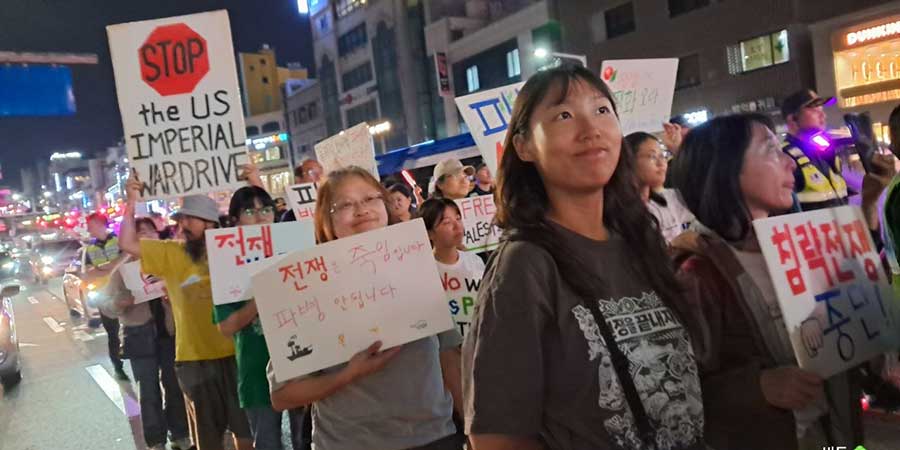
Gangjeong Peace Activists protest against the militarization of Jeju Island every day at the base. Photo Credit to Gangjeong Everyday Resistance Action.
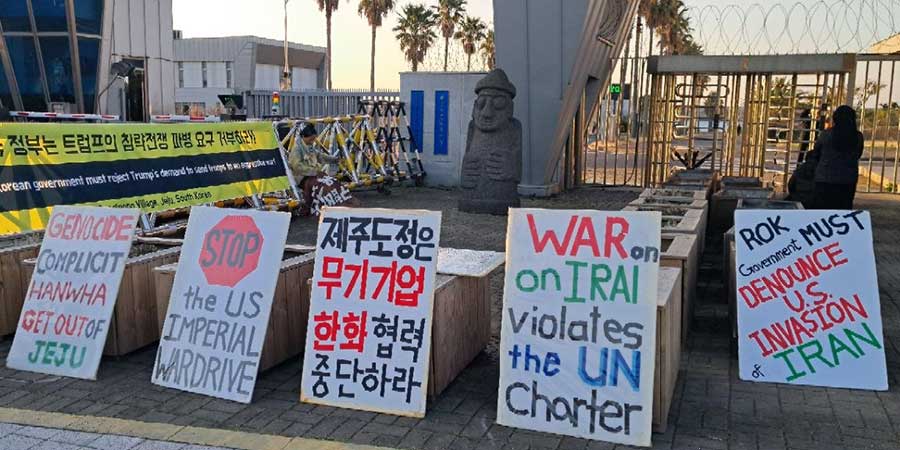
Gangjeong Peace Activists protest against the militarization of Jeju Island every day at the base. Photo Credit to Gangjeong Everyday Resistance Action.